2026 Best Master Alloys for Advanced Manufacturing Techniques?
In the evolving landscape of advanced manufacturing, Master Alloys play a crucial role. These alloys enhance mechanical properties and improve material performance. According to the International Journal of Advanced Manufacturing Technology, the global Master Alloy market is projected to reach $300 million by 2026. This significant growth reflects the rising demand for advanced applications in aerospace, automotive, and electronics.
Master Alloys allow for precise control in alloying processes. They facilitate innovation in product design and material optimization. However, not all Master Alloys perform equally; some may fail to deliver expected results. The need for thorough evaluation is paramount. The suitability of a particular Master Alloy can vary based on its application and composition.
Innovation in this field comes with challenges. High costs and complex processing techniques can hinder widespread adoption. Industry leaders must continuously assess and refine their choices. The focus should be on balancing performance and economic viability. This ongoing reflection on the best Master Alloys is vital for the future of advanced manufacturing.

What Are Master Alloys and Their Significance in Advanced Manufacturing?
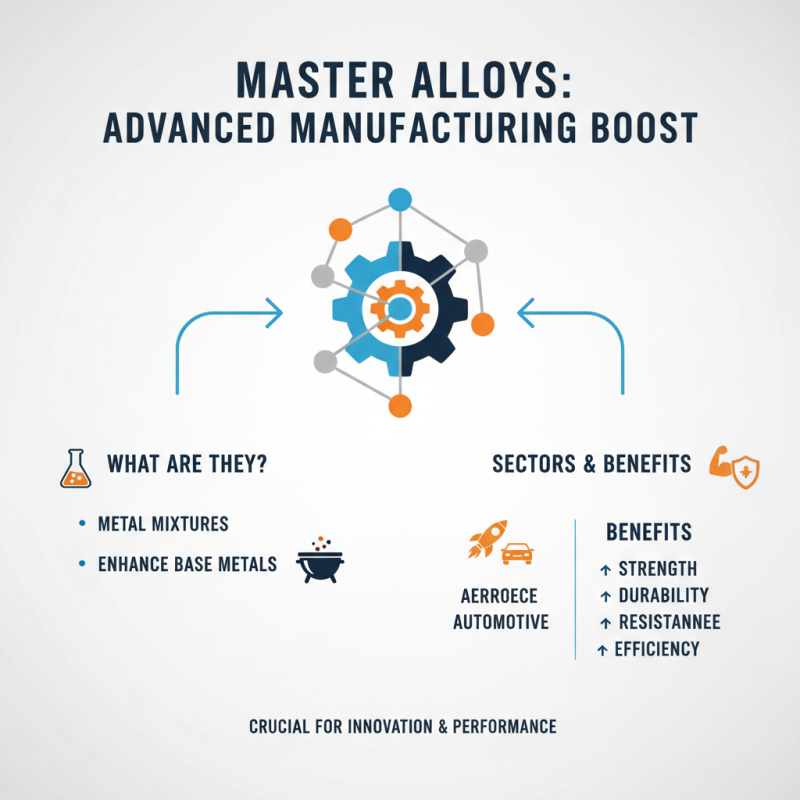
Master alloys are crucial in advanced manufacturing. They are metal mixtures that enhance the properties of base metals. In sectors like aerospace and automotive, these alloys are indispensable. Reports indicate that master alloys can improve strength, durability, and resistance to corrosion. These enhancements increase the efficiency of manufacturing processes.
The production of master alloys involves precise control over composition. Varying the ratio of elements can lead to different characteristics. For instance, aluminum master alloys contain elements like magnesium or silicon, which improve machinability. However, achieving the perfect blend requires meticulous attention. Even minor deviations can lead to significant performance drops.
As demand for advanced materials grows, the role of master alloys becomes more critical. Industry forecasts predict a compound annual growth rate of over 5% in the master alloys market through 2027. This growth indicates an increasing reliance on these materials. However, the challenge lies in ensuring consistency. Variability in production methods can lead to quality issues. Future research must focus on refining these processes for better reliability and performance.
Key Properties and Characteristics of the Best Master Alloys for 2026
The landscape of advanced manufacturing is evolving. In 2026, selecting the best master alloys will hinge on their specific properties. For instance, aluminum-lithium alloys are favored for their lightweight nature, reducing energy consumption in aerospace applications. These alloys can reduce weight by up to 15%, translating into significant fuel savings.
Another promising candidate is titanium-based alloys. They boast high strength and corrosion resistance. Data show that titanium alloys can withstand extreme temperatures, making them ideal for automotive and industrial applications. However, their cost remains a concern. While their performance is unmatched, the pricing can hinder widespread adoption.
Some master alloys struggle with specific issues. Certain magnesium alloys, while lightweight, can be susceptible to corrosion in marine environments. This presents a challenge for industries that need durability. Balancing cost, performance, and environmental factors will be crucial in the coming years. Innovations in alloy compositions could address these weaknesses, leading to better solutions for manufacturers.
Innovative Manufacturing Techniques Utilizing Master Alloys in 2026
In 2026, innovative manufacturing techniques are transforming the landscape of advanced manufacturing. Master alloys play a crucial role here. These specialized materials enhance the properties of base metals, leading to superior performance in various applications. For instance, they improve strength and corrosion resistance.
Additive manufacturing is one area where master alloys shine. By using these alloys in 3D printing processes, manufacturers can create complex geometries with enhanced material properties. This technique opens doors to design freedom. However, achieving consistent quality remains a challenge. Variations in alloy composition can lead to unpredictable results.
Another technique gaining traction is hybrid manufacturing. This combines traditional processes with additive methods. Master alloys enable better synergy between the two, enhancing productivity. Yet, the integration process can be complex. Understanding the behavior of these materials under different conditions is critical. Embracing this knowledge will set the foundation for future advancements.
2026 Best Master Alloys for Advanced Manufacturing Techniques
This chart showcases the performance ratings of various master alloys used in advanced manufacturing techniques for the year 2026. Each alloy is evaluated on a scale from 1 to 10, reflecting its suitability for innovative manufacturing applications.
Comparative Analysis of Leading Master Alloys for Various Applications
The choice of master alloys significantly impacts advanced manufacturing techniques. Various applications call for specific properties, such as strength, ductility, and corrosion resistance. A comparative analysis of leading master alloys reveals their unique strengths and limitations. For instance, alloy compositions that excel in tensile strength may compromise ductility. This trade-off can affect the final product's performance and reliability.
One key player in manufacturing is aluminum alloys. They are lightweight and versatile, making them suitable for many applications. However, their susceptibility to corrosion can be a drawback. Some high-performance applications might require additives to enhance protection. On the other hand, titanium alloys offer excellent strength-to-weight ratios but are often more challenging to process.
Market demands shift rapidly. This constant change creates pressure to innovate. Manufacturers must stay informed about new alloy formulations and technologies. They need to assess whether a new master alloy truly meets their needs or if it’s just a fleeting trend. Balancing these factors requires careful consideration and ongoing reflection on the evolving landscape of materials science.
Future Trends and Developments in Master Alloys for Advanced Manufacturing
As we delve into the future of master alloys, an emerging trend is the focus on lightweight materials for advanced manufacturing processes. According to a recent industry report by the Global Metal Alliance, the demand for lightweight alloys is projected to grow by 15% annually. This shift is driven by the need for fuel efficiency in aerospace and automotive sectors. Master alloys such as aluminum-lithium and titanium-aluminum are becoming indispensable.
Another significant trend is the development of environmentally friendly alloys. Researchers are exploring green technologies in alloy production. A study from the Sustainable Manufacturing Initiative suggests that adopting eco-friendly practices could reduce carbon emissions in alloy production by up to 30% by 2028. However, challenges remain. Many manufacturers lack the infrastructure or knowledge to implement these new methods.
Moreover, the customization of master alloys is becoming more critical for specific applications. Industries are requesting tailored solutions, pushing for a more agile production approach. Flexibility in alloy composition can enhance mechanical properties. Yet, this customization may lead to complexities in quality control and supply chain management. Balancing precision with scalability is a pressing concern for manufacturers navigating this evolving landscape.