How to Choose the Best Additive Manufacturing Metal Powder?
In the rapidly evolving landscape of additive manufacturing, choosing the right Additive Manufacturing Metal Powder is crucial. A report by Smithers Pira estimated that the metal 3D printing market will reach $4.72 billion by 2026. This growth underscores the importance of quality metal powders in achieving high-performance outcomes. Each powder’s composition, morphology, and flowability significantly influence the printing process and the final product properties.
Selecting the ideal powder isn't merely a technical challenge; it requires understanding application-specific requirements. For instance, aerospace components demand powders that withstand extreme conditions. Data from various studies indicate that the particle size distribution of metal powders plays a pivotal role in sintering behavior and mechanical performance. However, there is no one-size-fits-all solution. Manufacturers often struggle with balancing quality and cost-efficiency, leading to mistakes in powder selection.
Moreover, the continuous evolution of metal powder technology brings about uncertainty. New alloys and formulations frequently emerge, necessitating careful evaluation. The decision-making process can feel overwhelming when considering factors like powder production methods or post-processing requirements. This complexity highlights the need for expertise and reliable sources to inform choices in Additive Manufacturing Metal Powder selection.
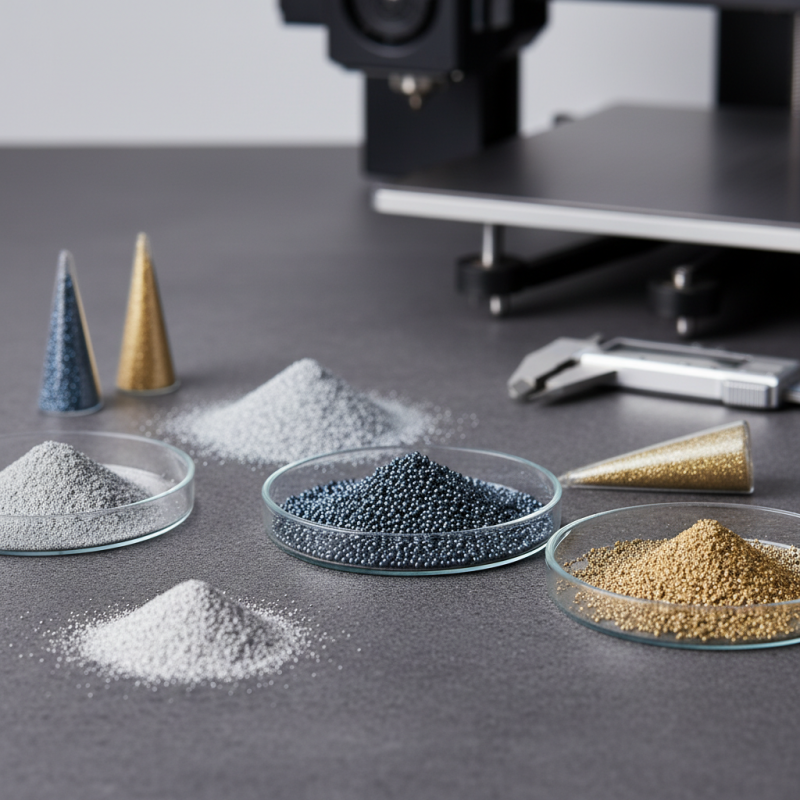
Factors to Consider When Choosing Metal Powders for Additive Manufacturing
When selecting metal powders for additive manufacturing, several factors come into play. The particle size distribution is crucial. Smaller particles can improve flowability, while larger particles may enhance building speed. However, finding the right balance is essential. Too small particles can lead to poor packing density, resulting in weak printed parts.
Chemical composition also significantly impacts the properties of the final product. Various alloys have unique characteristics that influence strength and durability. It’s vital to analyze the specific needs of your application. Some projects may require particular mechanical properties. Failing to account for this can lead to mechanical failures.
Tips: Identify the specific requirements of your application beforehand. Consider the desired mechanical properties and surface finish. Additionally, choose powders from reliable suppliers. Quality assurance should be a priority. Improper storage of powders can lead to contamination. This will affect the printing process and final product quality, so be mindful of handling procedures. Carefully evaluate each supplier's certification and quality control measures.
Factors Influencing the Choice of Metal Powders for Additive Manufacturing
Key Properties of Metal Powders Affecting Print Quality and Performance
When selecting metal powders for additive manufacturing, key properties significantly impact print quality and performance. Particle size, for instance, greatly influences layer adhesion. A study by the American Society for Testing and Materials highlights that optimal particle sizes range from 15 to 45 micrometers. This range ensures good flowability and packing density, which are vital for creating stable layers.
Another crucial aspect is the morphology of the powder. Spherical powders often provide better flow characteristics compared to irregular shapes. Research published by the Journal of Materials Science points out that spherical particles enhance uniformity in deposition. This uniformity results in fewer defects in the final product, improving structural integrity.
Tip: Always check the bulk density of the powder. Higher density typically signifies better quality and consistency in printing.
The chemical composition of the metal powder cannot be overlooked. Variations can affect the final product's mechanical properties, like tensile strength and ductility. The International Journal of Advanced Manufacturing Technology emphasizes the importance of maintaining tight control over the composition to avoid unexpected performance issues.
Tip: Consider performing small batch tests to evaluate how different compositions behave in actual printing scenarios. These tests provide insights that can drive improvements in future printing processes.
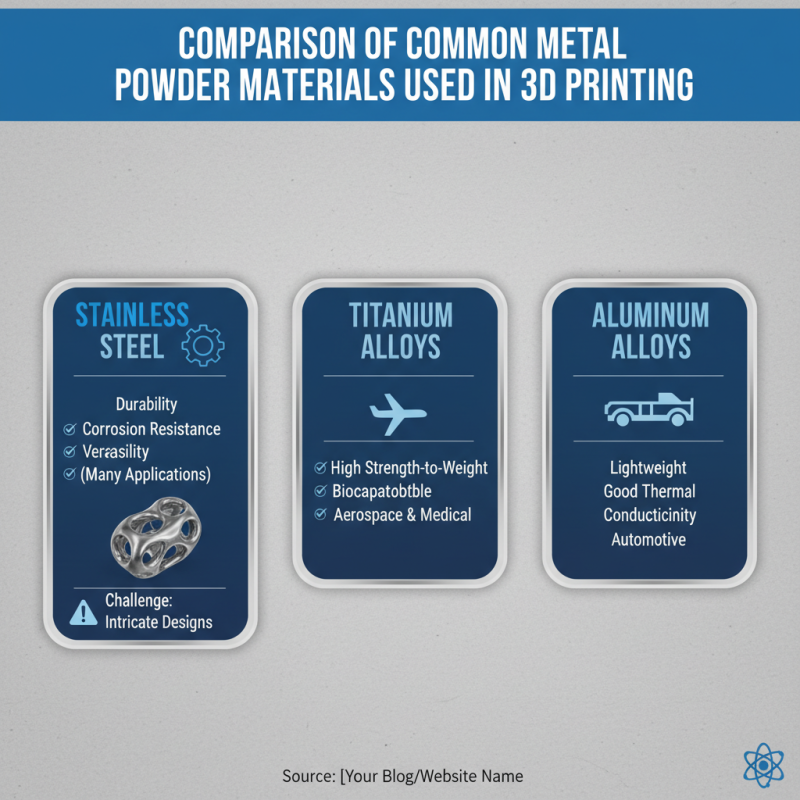
Comparison of Common Metal Powder Materials Used in 3D Printing
When selecting metal powders for additive manufacturing, various materials stand out. Stainless steel is widely used due to its durability and corrosion resistance. Its versatility makes it suitable for many applications. However, it can be challenging to process, especially for intricate designs.
Titanium alloys are another popular choice. They offer excellent strength-to-weight ratios, making them ideal for aerospace components. Yet, they can be expensive and difficult to handle. The need for skilled technicians to process titanium effectively cannot be overlooked.
Aluminum powders are lightweight and cost-effective. They are often chosen for prototypes and lightweight structures. However, they may not provide the same strength as other metals. Users should research their specific application needs. Each material has its unique benefits and drawbacks, thus requiring careful consideration. Understanding these qualities can lead to better final products in 3D printing.
The Role of Particle Size and Shape in Metal Powder Selection
Selecting the right metal powder for additive manufacturing is crucial. Particle size and shape play significant roles in this process. The diameter of the powder particles affects flowability, packing density, and thermal conductivity. Smaller particles often enhance resolution but may lead to issues with powder flow during the printing process.
Shape is equally important. Spherical powders tend to provide better flow characteristics compared to irregularly shaped particles. This can be especially significant in processes requiring precise layer deposition. However, achieving a perfectly spherical shape can be challenging, potentially affecting manufacturing efficiency.
Understanding these factors requires experience and careful consideration. Manufacturers often face trade-offs. Sometimes, a balance between particle size, shape, and application needs leads to compromises. Overlooking these details can result in poor print quality or mechanical properties, prompting a need for ongoing reflection on the selection processes being employed. Keeping current with advancements in powder metallurgy is essential for long-term success.
Industry Standards and Certifications for Metal Powders in AM Applications
When selecting metal powders for additive manufacturing (AM), understanding industry standards and certifications is crucial. Compliance with these guidelines ensures quality and performance. Common certifications include ISO 9001, which indicates a strong quality management system, and ISO 13485 for medical devices. A powder that meets these standards likely has undergone rigorous testing for purity and performance.
Check for traceability in the material. This means knowing the source of the metal powder and how it was processed. Additionally, the powder should meet specific particle size distribution. This affects flowability and compaction. Inconsistent particle size can lead to defects in the final product.
**Tips:** Always ask suppliers for documentation on certifications and test reports. Verifying the history of the powder can prevent future issues. Be wary of generic claims; detailed specifications are essential. Utilizing powders from reputable sources reduces risks associated with material failure in AM applications.
How to Choose the Best Additive Manufacturing Metal Powder? - Industry Standards and Certifications for Metal Powders in AM Applications
| Powder Type |
Standard Compliance |
Particle Size Range (µm) |
Density (g/cm³) |
Applications |
| Titanium Alloy (Ti-6Al-4V) |
ASTM F2885 |
20 - 50 |
4.43 |
Aerospace, Medical |
| Aluminum Alloy (AlSi10Mg) |
ASTM B917 |
10 - 40 |
2.70 |
Automotive, Aerospace |
| Stainless Steel (316L) |
ASTM A6/A6M |
30 - 60 |
8.00 |
Medical, Industrial |
| Cobalt Chrome (CoCr) |
ISO 5832-12 |
20 - 45 |
8.50 |
Medical, Aerospace |
| Nickel Alloy (Inconel 718) |
AMS 5596 |
15 - 45 |
8.19 |
Aerospace, Oil & Gas |