What is High Melting Point Alloys and Why Are They Important?
High Melting Point Alloys are materials with exceptional resistance to deformation at high temperatures. They play a crucial role in various industries, particularly in aerospace and nuclear applications. These alloys maintain their structural integrity under extreme heat, ensuring safety and efficiency.
The importance of High Melting Point Alloys cannot be overstated. They enable the development of advanced engines and reactors that operate at high temperatures. This capability leads to improved performance and fuel efficiency. However, not all alloys are equal. Some may not withstand the demands of specific applications, raising concerns about their reliability.
Research and innovation continue to evolve in this field. Scientists are constantly seeking to enhance the properties of High Melting Point Alloys. Yet, challenges remain in finding sustainable materials that meet stringent performance criteria. Reflecting on these issues is vital for future advancements.
Definition and Characteristics of High Melting Point Alloys
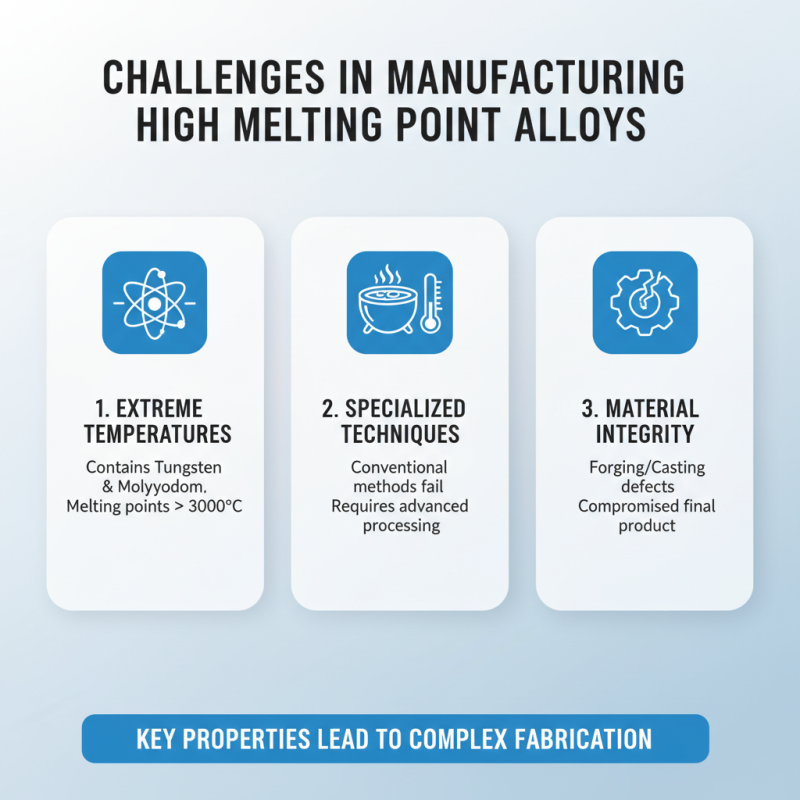
High melting point alloys are a special group of metals that maintain their strength and stability at high temperatures. These alloys typically have melting points above 1,650°C. They often contain elements like tungsten, molybdenum, and tantalum. Their ability to withstand extreme heat makes them essential in aerospace, automotive, and energy sectors.
These alloys exhibit unique characteristics. They resist wear, corrosion, and oxidation. This durability is vital for components in engines, turbines, and reactors. Industries rely on high melting point alloys for reliability and performance under stress. However, working with these materials can be challenging. They often require specialized manufacturing techniques and tools.
Tips: When selecting an alloy, consider its thermal stability and mechanical properties. Collaborate with experts to address any potential challenges in your project. Choosing the right materials can make a significant difference in performance and longevity. Always stay informed about advancements in alloy technology.
High Melting Point Alloys: Characteristics and Importance
Applications of High Melting Point Alloys in Industry
High melting point alloys are essential in various industrial applications due to their resistance to high temperatures and corrosion. These alloys typically contain elements like tungsten, molybdenum, and tantalum. Their capability to withstand extreme conditions makes them ideal for aerospace components. For instance, jet engines and rocket propulsion systems rely heavily on these materials.
In the automotive sector, high melting point alloys serve crucial roles in manufacturing engine parts and exhaust systems. They ensure durability even when exposed to high heat. Some manufacturers have noted that, despite the advantages, these alloys can be challenging to work with due to their hardness and brittleness. This complexity may lead to increased production costs and longer manufacturing times.
Moreover, in electronics, high melting point alloys are often used in soldering applications. Their ability to maintain structural integrity at elevated temperatures is vital. However, the development of these alloys must continually evolve to address environmental concerns. The quest for greener alternatives is ongoing but poses its own difficulties. Balancing performance and sustainability challenges engineers and manufacturers alike.
Benefits of Using High Melting Point Alloys
High melting point alloys are critical in various industries due to their outstanding resistance to heat and deformation. These alloys typically contain elements like tungsten, molybdenum, and tantalum. They maintain structural integrity at elevated temperatures, which is essential in aerospace and power generation. Their ability to withstand extreme conditions makes them ideal for turbine blades and engine components.
Using high melting point alloys brings several benefits. They reduce the frequency of maintenance and replacement, saving costs over time. These alloys also enhance the efficiency of machinery by operating at higher temperatures. This increase in operational efficiency can lead to significant energy savings. However, processing these materials can be challenging due to their unique properties. It requires specialized techniques and tools, which can increase initial production costs.
Despite the advantages, manufacturers must navigate some drawbacks. The sourcing of raw materials can be limited and affect availability. Additionally, while these alloys offer remarkable performance, they may not be suitable for every application. Engineers must carefully evaluate their specific needs before selecting materials. Balancing performance with cost and practicality is essential in the decision-making process.
What is High Melting Point Alloys and Why Are They Important? - Benefits of Using High Melting Point Alloys
| Alloy Type |
Melting Point (°C) |
Benefits |
Applications |
| Tungsten Alloy |
3422 |
High-density, excellent heat resistance |
Aerospace, medical devices |
| Molybdenum Alloy |
2623 |
Outstanding thermal stability, corrosion resistant |
Nuclear reactors, high-temperature furnaces |
| Tantalum Alloy |
3017 |
Highly biocompatible, excellent corrosion resistance |
Medical implants, chemical processing |
| Rhenium Alloy |
3186 |
Exceptional thermal and electrical conductivity |
Aerospace applications, thermocouples |
| Niobium Alloy |
2477 |
Resistant to oxidation, high melting point |
Superconductors, rocket engines |
Future Trends in High Melting Point Alloys Research and Development
Research into high melting point alloys is evolving rapidly. Industry experts note a significant shift towards applications in aerospace and power generation. According to a report by Grand View Research, the global market for high melting point alloys is projected to reach USD 450 million by 2025, growing at a CAGR of around 5%. This growth reflects a demand for materials that can withstand extreme temperatures and pressures.
Engineers are exploring new formulations for these alloys to improve performance. Researchers are examining how microstructural changes influence thermal resistance. Recent studies have shown that certain alloy compositions can enhance performance by 15% or more under high-stress conditions. However, challenges remain. The difficulty in processing these materials can lead to inconsistencies in production.
Innovative techniques like additive manufacturing are gaining traction. These methods promise to reduce waste and increase design flexibility. A report from the International Journal of Research notes that combining advanced manufacturing techniques with high melting point alloys could open new avenues. Yet, the need for standardization and quality assurance in production processes poses questions that the industry must address.