What are Spray Powders and Their Applications in Industry?
In today's industrial landscape, the innovation of Spray Powders plays a crucial role. “Spray powders are transformative for manufacturing processes,” states Dr. Lisa Chang, a leading expert in materials science. Her insights highlight the growing significance of these materials.
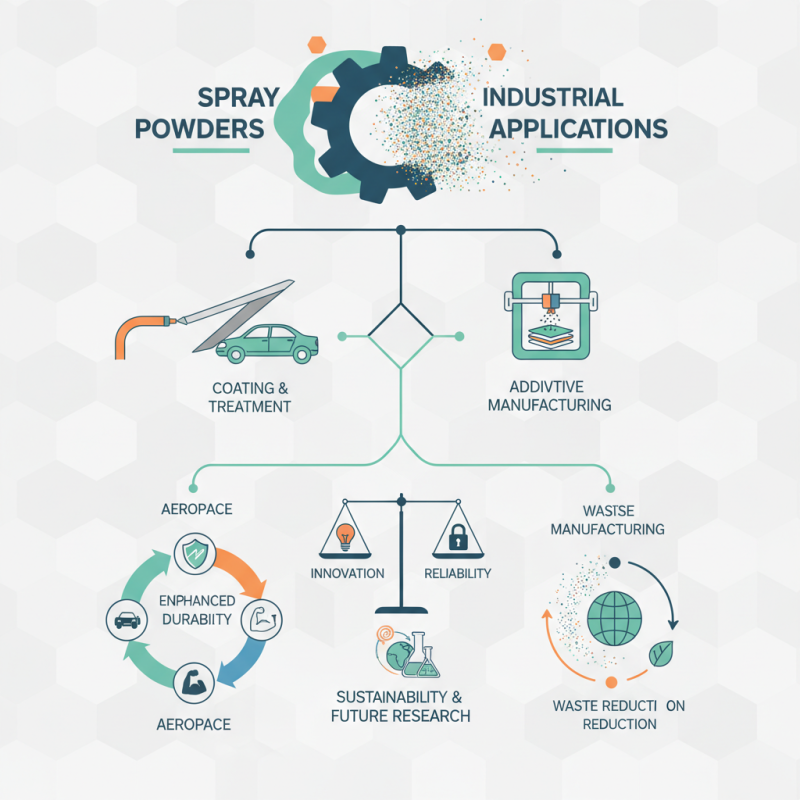
Spray Powders are fine particles used in various applications like coating, additive manufacturing, and surface treatment. Industries such as aerospace and automotive are increasingly adopting these powders. They enhance performance, improve durability, and reduce waste. However, the challenge remains in ensuring quality and consistency in production.
As companies pivot to more sustainable practices, the role of Spray Powders might evolve. There is an ongoing need for research into better materials and processes. This evolution may prompt reflection on the industry's standards and methodologies. Balancing innovation and reliability remains essential for future advancements.
Definition and Composition of Spray Powders in Industrial Applications
Spray powders are finely milled particles used in various industrial applications. Their composition typically includes metals, ceramics, and polymers. The unique properties of these materials make them suitable for additive manufacturing, coatings, and thermal spray processes.
The creation of spray powders requires precise methods to ensure uniform particle size and distribution. A diverse range of techniques, such as gas atomization and mechanical milling, are employed to achieve the desired qualities. This fine control over composition impacts the performance of the final products, making accuracy essential.
Tip: When selecting spray powders, consider the specific application requirements. Analyze factors like thermal stability and particle morphology. Testing different compositions can help identify the most effective options.
Spray powders also play a role in powder metallurgy. In this process, powders are compacted and sintered to form solid parts. The ability to customize powder properties enhances the versatility of this method. However, controlling the manufacturing environment is critical to prevent contamination. This aspect often requires reflection on the chosen processes.
Tip: Always evaluate the source of your spray powders. Ensure reliable suppliers can provide consistent quality. Conduct regular assessments to maintain standards and prevent deviations in production.
Key Characteristics and Properties of Effective Spray Powders
Spray powders are fine particulate materials used in different industries for various applications. Their effectiveness depends largely on their key characteristics and properties. One important aspect is particle size. Smaller particles provide a larger surface area, enhancing reactivity and dispersion. This is crucial in industries like pharmaceuticals, where precise dosing and uniformity are essential.
Another key characteristic is flowability. Effective spray powders should have good flow properties to ensure consistent delivery during production processes. Powders that clump or cake can lead to uneven application, resulting in defects in the final product. This can be a major concern in areas like coatings and food production.
Tips: Monitor humidity levels in storage areas. High moisture can negatively affect powder properties. Regularly test powder flowability to ensure optimal performance. Adjusting particle size can also improve process efficiency, though it may require additional testing. Always consider the impact of variations on product quality. Reflect on past experiences to make informed adjustments.
What are Spray Powders and Their Applications in Industry? - Key Characteristics and Properties of Effective Spray Powders
| Property |
Description |
Applications |
| Particle Size |
Typically ranges from 1 to 100 microns. |
Coatings, additive manufacturing. |
| Flowability |
Ability to flow and fill molds or spray nozzles effectively. |
3D printing, powder metallurgy. |
| Composition |
May include metals, ceramics, and polymers. |
Manufacturing of parts, thermal barrier coatings. |
| Thermal Stability |
Resistance to heat during application processes. |
Aerospace, automotive applications. |
| Adhesion |
Ability to bond effectively to substrates. |
Surface treatment, protective coatings. |
| Cost-Effectiveness |
Economic considerations in large-scale applications. |
Bulk manufacturing processes. |
Major Industries Utilizing Spray Powders: Case Studies and Statistics
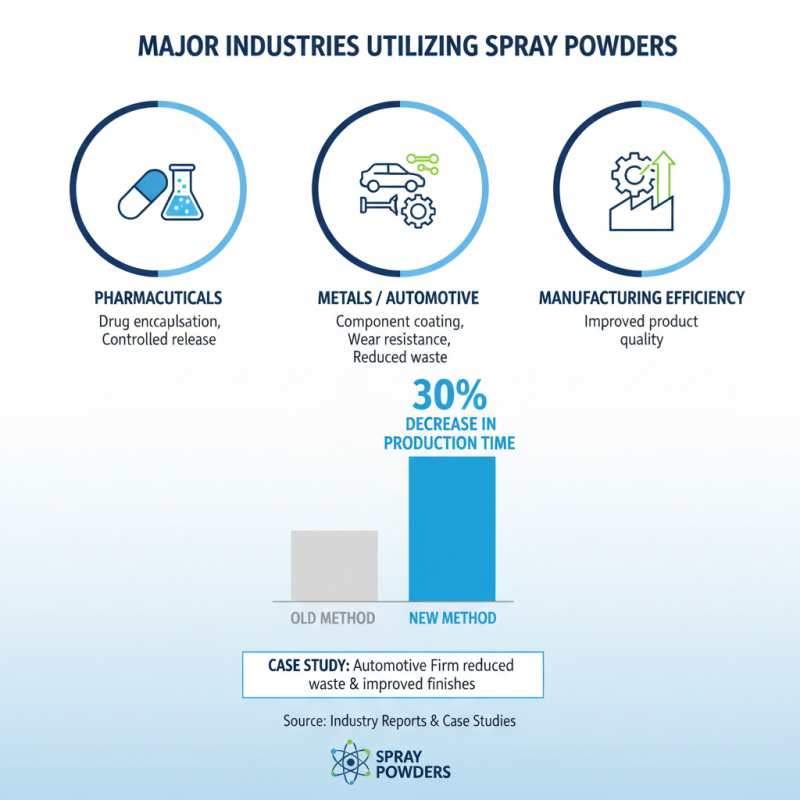
Spray powders are versatile materials used across various industries. Their applications span from pharmaceuticals to metals. Case studies reveal significant benefits in manufacturing efficiency and product quality. For instance, a major automotive firm adopted spray powders for coating components. This method reduced waste and improved surface finishes. Statistics show a 30% decrease in production time due to these innovations.
In the food industry, spray powders help enhance flavor and extend shelf life. A respected dairy company employed a spray drying process to create powdered milk. This adjustment led to a notable 25% increase in sales. Reliable studies back these outcomes, making spray powders an essential resource.
**Tip:** When choosing spray powders, consider their particle size and distribution. These factors greatly influence performance.
**Tip:** Keep an eye on emerging technologies in spray powder applications. The industry evolves rapidly, and staying informed can offer a competitive edge.
Though the benefits are clear, some companies face challenges in implementing spray powder systems. It can be difficult to ensure consistency in quality. Continuous monitoring and investment in training help mitigate this risk.
Technological Advancements in Spray Powder Production and Application
Spray powders have transformed various industries through advanced production processes. Recent studies reveal that the global spray powder market is expected to grow significantly, reaching a valuation of approximately $15 billion by 2026. This growth is driven by innovations in materials and techniques, particularly in additive manufacturing and surface coatings. These advancements have enabled precise control over particle size and distribution, enhancing performance characteristics.
New technologies like laser and ultrasonic techniques are enhancing the production of spray powders. For instance, recent research indicates that optimized processing parameters can reduce production costs by up to 30%. However, challenges remain in ensuring consistency and reliability in large-scale production. Issues such as batch variability can impact end-user applications significantly, necessitating ongoing quality control measures.
Emerging industries, particularly in aerospace and biomedical fields, are exploring novel spray powder applications. These sectors require high-performance materials that can withstand extreme conditions. The adaptability of spray powders makes them suitable for customizations, yet this flexibility also leads to complexities in regulatory compliance. As manufacturers push for innovation, balancing performance and safety will be critical going forward.
Applications of Spray Powders in Various Industries
Future Trends and Innovations in the Spray Powder Market and Industry
The spray powder market is evolving rapidly. In 2023, the global value of the spray powder market reached approximately $4 billion. This figure is expected to grow at a CAGR of around 7% through 2030, driven by key industries like automotive, aerospace, and healthcare. Innovations in spray technology are at the forefront of this growth, promising improved efficiency and reduced waste.
One notable trend is the advancement in coating technologies. Surface treatment solutions are becoming more sophisticated. For example, thermal spray coatings enhance durability and resistance to environmental factors. These technologies require precise formulation and application. However, some challenges remain. Manufactures often deal with inconsistencies in particle size and shape, which can affect performance.
Sustainability also plays a significant role in future applications. Many industries are moving towards eco-friendly alternatives in spray powders. This shift is guided by increasing regulations and consumer demand. However, the transition presents hurdles. Manufacturers must balance performance with environmental impact. Existing production methods may not always meet these new standards, requiring ongoing innovation and adaptation.