7 Best Spray Powders for Industrial Applications
Industrial manufacturers rarely choose Spray Powders by price alone. Surface temperature, wear type, equipment settings, and production volume can change the result. A powder that performs well on a pump shaft may fail on a turbine blade. The details matter.
This guide examines seven Spray Powders used across demanding industrial applications. It considers aluminum oxide for electrical insulation, chromium oxide for abrasive wear, tungsten carbide blends for severe erosion, and nickel-based powders for corrosion resistance. It also reviews ceramic, metallic, and self-fluxing options. Each choice involves trade-offs involving hardness, adhesion, porosity, surface finish, and repairability. Some coatings need controlled substrate preparation. Others require precise heat input and skilled post-machining.
Dr. Sanjay Sampath, a respected thermal-spray researcher, has emphasized that “thermal spray is a process, not merely a material.” That principle deserves attention. Powder selection alone cannot guarantee a durable coating. Incorrect particle velocity, moisture, or surface cleanliness can undermine excellent feedstock. Sometimes, the “best” powder is simply the wrong solution for the operating environment.
The comparison ahead focuses on practical industrial conditions. It considers temperature, friction, impact, chemical exposure, and maintenance demands. Laboratory data can look impressive. Factory results may differ. Readers should verify supplier specifications, application limits, and relevant safety requirements before implementation. A careful trial remains valuable, even when the technical datasheet appears convincing.
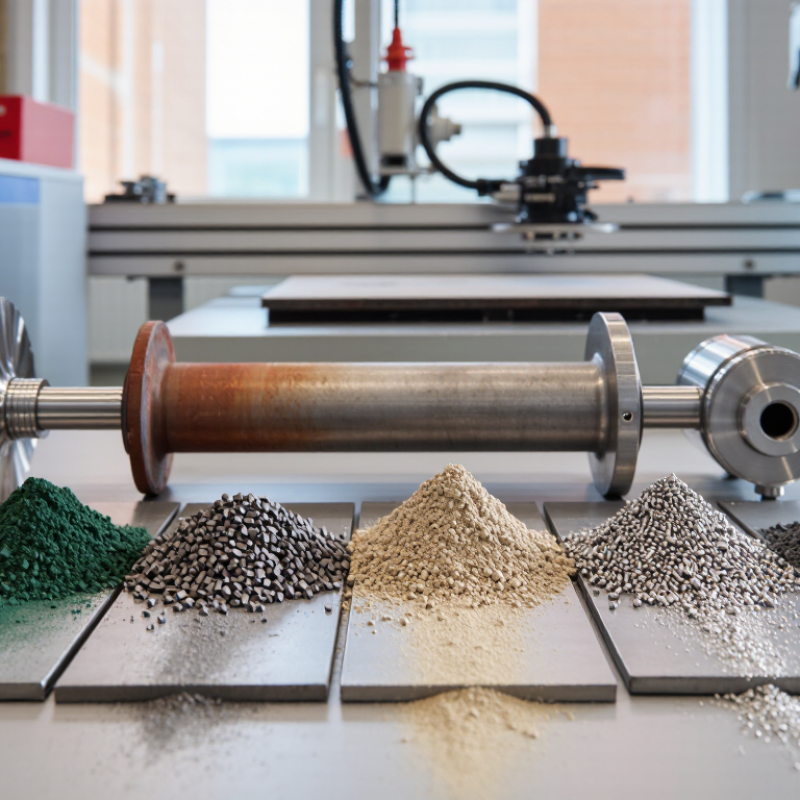
Classifying 7 Spray Powders by Function, Hardness, and Service Temperature
7 Best Spray Powders for Industrial Applications
Industrial spray powders should be classified by function, hardness, and service temperature. In field repairs, the wrong powder often fails before the coating looks damaged. A worn steel shaft may need dimensional restoration, while a furnace component needs thermal insulation. These are different jobs. The seven useful powder families include nickel-based self-fluxing alloys, iron-based alloys, tungsten carbide-cobalt, chromium carbide-nickel chromium, alumina, zirconia, and copper-based alloys.
Nickel, Iron & Carbide Powders
Nickel-based powders suit sealing and general wear, with hardness commonly near 35–60 HRC and service temperatures around 600–1,000°C. Iron-based powders offer economical abrasion resistance, usually below 500°C. Tungsten carbide-cobalt provides extreme hardness, often above 900 HV, but may lose performance under intense heat.
High-Temperature Performance
Chromium carbide-nickel chromium handles hotter oxidation environments, sometimes approaching 800°C. Hardness matters here. So does impact.
Ceramic, Thermal Barrier & Copper-Based Options
Alumina coatings resist electrical wear and abrasion, with hardness near 1,800–2,200 HV. Zirconia is softer, but its porous structure reduces heat transfer in thermal barrier applications above 1,000°C. Copper-based powders support conductivity and low-friction repairs, although they suit lower temperatures. Actual limits depend on spray process, substrate preparation, coating thickness, and atmosphere. I have seen promising coatings fail because surface roughness was ignored. Testing should include temperature cycling, adhesion checks, and the real contact load. A neat laboratory result is not always a reliable production result.
Alumina, Zirconia, and Chromia Powders for 800–1,200°C Thermal Barriers
7 Best Spray Powders for Industrial Applications
Alumina, Zirconia, and Chromia Powders for 800–1,200°C Thermal Barriers
Thermal spray powders for 800–1,200°C service must balance insulation, adhesion, and thermal cycling. Alumina offers strong hardness and electrical insulation. Zirconia provides low thermal conductivity and tolerates repeated temperature changes. Chromia performs well where abrasion, oxidation, and chemical exposure occur.
Seven practical powder choices include alumina, zirconia, chromia, alumina-zirconia blends, stabilized zirconia, mullite, and aluminum titanate. Stabilized zirconia can reduce cracking during rapid heating. Mullite suits rigid ceramic barriers with moderate thermal expansion. Aluminum titanate handles heat efficiently, although its mechanical stability needs careful evaluation. Particle size matters. Fine powder may improve surface coverage, while oversized particles can create rough, weak regions.
A sound coating begins with a clean, profiled substrate and controlled spray parameters. Keep it controlled. Operators should inspect porosity, thickness, bond strength, and surface temperature after spraying. Small details matter. A coating that looks uniform may still fail near edges or mounting points. Laboratory coupons should experience several heating and cooling cycles before production approval. I have found that real equipment often exposes problems that single-temperature testing misses. Moisture, vibration, and uneven heating can change the result. The best powder is not always the most insulating one; it must match the substrate, spray process, and actual thermal profile.
Tungsten Carbide and Cr₃C₂–NiCr Powders Delivering Over 1,000 HV Wear Resistance
7 Best Spray Powders for Industrial Applications
Tungsten Carbide and Cr₃C₂–NiCr Powders Delivering Over 1,000 HV Wear Resistance
In demanding plants, powder selection often determines whether a coating survives weeks or several years. Tungsten carbide powders can produce coatings exceeding 1,000 HV, creating a hard barrier against sliding wear, particle erosion, and repeated contact. They suit pump sleeves, shafts, valves, and forming tools exposed to abrasive particles.
Cr₃C₂–NiCr powders offer a different balance. Their chromium carbide particles resist wear at elevated temperatures, while the nickel-chromium binder supports adhesion and oxidation resistance. These powders are commonly applied through high-velocity thermal spraying, where controlled particle speed helps reduce porosity. The result can be a dense surface with stable performance in hot, corrosive equipment.
Powder size matters.
Technicians should match particle distribution with the spray system, coating thickness, and substrate geometry. Surface preparation is equally important; oil, scale, or weak grit profiles can undermine even excellent powder. In practical coating work, hardness readings above 1,000 HV are useful, but they do not guarantee service life. Impact loading, thermal cycling, and lubrication may change the outcome. A very hard layer can still crack when the process window is poorly controlled. That part is easy to overlook.
Quality checks should include microstructural inspection, hardness mapping, bond-strength testing, and porosity measurement. Operators should also review actual wear patterns after service. Laboratory results help, but field evidence often reveals the uncomfortable details.
7 Best Spray Powders for Industrial Applications - Tungsten Carbide and Cr3C2–NiCr Powders Delivering Over 1,000 HV Wear Resistance
| No. |
Powder Type |
Nominal Composition |
Typical Particle Size |
Recommended Spray Process |
Typical Coating Hardness |
Approx. Service Temperature |
Key Industrial Applications |
| 1 |
WC–10Co–4Cr |
Tungsten carbide with approximately 10% cobalt and 4% chromium |
15–45 μm |
HVOF or HVAF |
1,100–1,400 HV0.3 |
Up to approximately 500°C in wear service |
Hydraulic rods, pump components, valve seats, oil and gas wear parts, aerospace actuator components |
| 2 |
WC–12Co |
Tungsten carbide with approximately 12% cobalt binder |
15–45 μm |
HVOF or HVAF |
1,050–1,350 HV0.3 |
Up to approximately 450–500°C |
Mining equipment, drilling tools, mechanical seals, sliding surfaces, wear plates and sleeves |
| 3 |
WC–17Co |
Tungsten carbide with approximately 17% cobalt binder |
20–53 μm |
HVOF, HVAF or high-velocity plasma spray |
1,000–1,250 HV0.3 |
Up to approximately 450°C |
Impact-prone components, agricultural wear parts, conveyor components, guide rollers and general abrasion protection |
| 4 |
WC–Ni |
Tungsten carbide in a nickel-based metallic binder |
15–45 μm |
HVOF or HVAF |
1,000–1,250 HV0.3 |
Up to approximately 500°C; useful where cobalt-free chemistry is preferred |
Chemical-processing equipment, valves, pumps, slurry-handling parts and corrosion–abrasion environments |
| 5 |
Cr3C2–25NiCr |
Approximately 75% chromium carbide and 25% nickel–chromium binder |
15–45 μm |
HVOF or HVAF |
1,000–1,200 HV0.3 |
Up to approximately 800°C |
Hot-section components, boiler tubes, turbine parts, furnace hardware and high-temperature sliding wear surfaces |
| 6 |
Cr3C2–20NiCr |
Approximately 80% chromium carbide and 20% nickel–chromium binder |
15–45 μm |
HVOF or HVAF |
1,050–1,300 HV0.3 |
Up to approximately 800°C |
High-temperature erosion, combustion equipment, exhaust components, pump sleeves and paper-industry rolls |
| 7 |
Cr3C2–NiCr–Mo |
Chromium carbide with a nickel–chromium binder modified with molybdenum |
15–45 μm |
HVOF or HVAF |
1,000–1,200 HV0.3 |
Up to approximately 750–800°C |
Corrosive high-temperature service, chemical pumps, marine components, sealing surfaces and erosion-resistant tooling |
Technical note: Hardness values are representative ranges for dense, properly deposited coatings measured using the Vickers method at approximately HV0.3. Actual results depend on powder morphology, particle-size distribution, spray parameters, substrate preparation, coating thickness and test method. Maximum service temperature refers to typical wear-service guidance rather than a universal material limit.
Selecting 5–150 μm Particle Sizes and Verifying Adhesion Under ASTM C633
Industrial spray powder selection begins with particle size, not color or catalog language. A 5–150 μm range covers very different feeding and melting behaviors. Fine particles can melt quickly, but they may agglomerate or drift during spraying. Coarser particles usually feed more steadily, yet they may leave unmelted cores. Published thermal-spray process surveys commonly place many feedstock grades between 15 and 100 μm. That range is practical, but it is not universal.
Verify adhesion with ASTM C633-13(2022), which measures tensile bond strength between the coating and substrate. Prepare identical test coupons. Record substrate roughness, spray distance, gas settings, powder feed rate, and failure location. The fracture face matters. Adhesion failure at the interface suggests poor preparation. Cohesive failure inside the coating may indicate weak splat bonding. A single high result can mislead. I have seen excellent numbers from poorly controlled surfaces.
Tips: Start with a narrow size fraction, such as 20–63 μm, then compare it against a coarser fraction. Check sieve analysis before spraying. Review at least five ASTM C633 specimens, not one. Keep adhesive strength above the expected coating requirement, while reporting the adhesive’s own limit. ASTM C633 does not replace production validation. Industrial reliability reports and coating qualification guidance repeatedly stress process consistency, traceability, and failure-mode analysis. Record the powder lot, humidity, storage time, and operator adjustments. Small omissions become large uncertainties.
7 Best Spray Powders for Industrial Applications
Typical thermal-spray feedstock particle-size windows, with practical selection guidance for 5–150 μm powders
The ranges shown are commonly used industrial feedstock bands for thermal-spray processing. Actual suitability depends on the spray process, powder morphology, chemistry, substrate preparation, and equipment settings.
Adhesion should be verified experimentally using ASTM C633, “Standard Test Method for Adhesion or Cohesion Strength of Thermal Spray Coatings.” ASTM C633 does not define a universal pass/fail value; acceptance limits must be established for the application.