What are the Benefits and Uses of Ni Powder?
Nickel powder, often referred to as Ni powder, boasts numerous benefits and applications across various industries. Dr. Sarah Lin, a leading expert in materials science, states, "Ni powder is indispensable for advancements in battery technology and additive manufacturing." This highlights the significance of Ni powder in today's technological landscape.
In the realm of energy storage, Ni powder plays a vital role in enhancing battery performance. Its unique properties make it an excellent choice for nickel-based batteries, leading to higher energy density and improved longevity. Additionally, in additive manufacturing, Ni powder is key for creating complex metal structures that are lightweight yet strong.
However, it is essential to note that handling Ni powder requires caution. The fine particles can pose health risks if not managed properly. This emphasizes the need for safety protocols in industrial settings. Despite its many advantages, the industry must practice responsible manufacturing and use of Ni powder to mitigate potential hazards.

Benefits of Nickel Powder in Various Industries
Nickel powder is gaining traction in various industries due to its unique properties. In metallurgy, it plays a crucial role. Its ability to improve corrosion resistance makes it valuable in manufacturing stainless steel. Such alloys are essential in environments where durability matters. This includes marine applications and chemical processing.
In the field of batteries, nickel powder is significant. It enhances the performance of nickel-metal hydride batteries. These batteries are used in electric vehicles and portable electronics. The efficiency of power storage directly impacts battery life. However, integrating nickel powder into production requires careful consideration. The particle size and distribution must be optimized for best results.
Another area of interest is additive manufacturing. Nickel powder is often used in 3D printing processes. It allows for the creation of complex geometries not feasible with traditional methods. But, achieving consistent quality can be challenging. Variations in powder characteristics may lead to defects. This highlights the need for ongoing research and development in this field.
Benefits of Nickel Powder in Various Industries
This chart illustrates the usage of Nickel Powder across different industries, highlighting its significance in aerospace, automotive, electronics, chemical applications, and batteries.
Applications of Nickel Powder in Battery Technology
Nickel powder is gaining attention in battery technology for its unique properties. This material plays a vital role in enhancing the performance and efficiency of batteries. Nickel's high electrical conductivity improves energy transfer within cells, leading to longer-lasting power. Moreover, its ability to withstand high temperatures makes it suitable for various battery types.
In lithium-ion batteries, nickel powder contributes to the production of cathodes. These structures are crucial for energy storage and delivery. Nickel enhances capacity and energy density, resulting in batteries that can store more energy in smaller spaces. Recent advancements show that the incorporation of nickel can lead to faster charging times, a feature increasingly desirable in modern devices.
Despite its benefits, there are challenges. Recycling nickel powder remains a complicated process. Environmental impact considerations must also be addressed. Researchers continue to explore solutions to these issues, striving for sustainable practices in nickel powder production and usage. The future of batteries may rely heavily on these innovations, making nickel powder a focal point in sustainable energy technology.
Role of Nickel Powder in Catalytic Processes
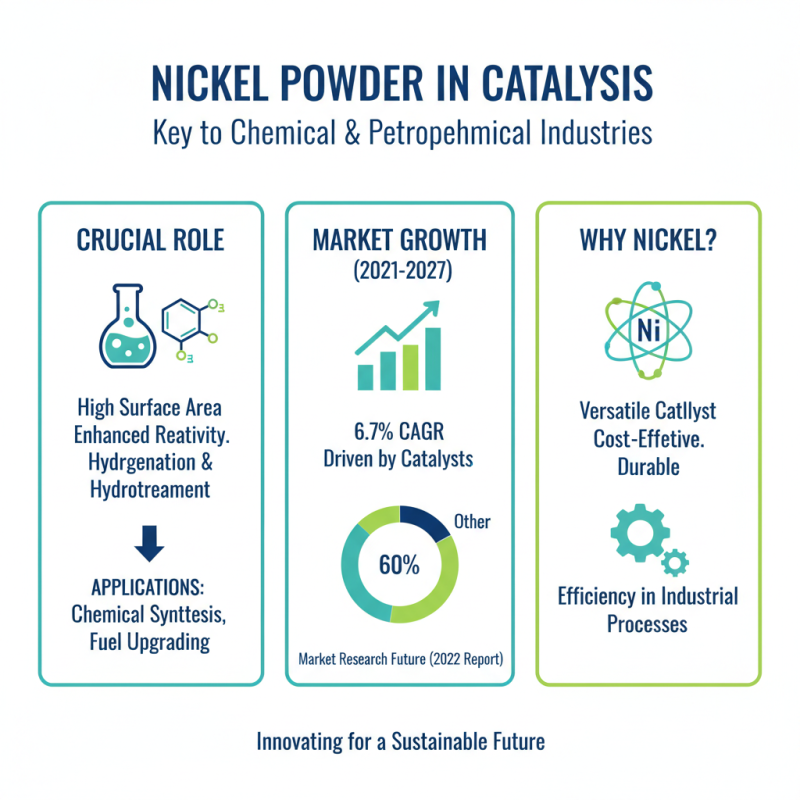
Nickel powder plays a crucial role in catalytic processes, particularly in the chemical and petrochemical industries. It is esteemed for its high surface area and catalytic activity. According to a 2022 report by Market Research Future, the nickel powder market is expected to grow at a CAGR of 6.7% from 2021 to 2027. This growth is largely driven by its applications in catalysts for hydrogenation and hydrotreatment processes.
In hydrogenation, nickel powder serves as an effective catalyst for reducing double bonds in organic compounds. This helps in the production of valuable intermediates. For instance, in the production of fatty acids from vegetable oils, nickel is a key ingredient. The 2021 Chemical Engineering Journal noted that nickel catalysts could improve reaction rates significantly, making processes more efficient.
Despite these advantages, challenges persist. The sensitivity of nickel to oxidation under high temperatures can reduce its efficacy. Additionally, the deactivation of nickel in various reactions due to sintering or poisoning can impact yield. Researchers are continuously seeking ways to enhance the stability and longevity of nickel-based catalysts. Innovations are necessary to address these concerns for future applications.
Advantages of Using Nickel Powder in Metal Alloys
Nickel powder plays a vital role in the creation of advanced metal alloys. One primary advantage is its ability to improve mechanical properties. Alloys that contain nickel are often more durable, enhancing strength and resistance to wear. This makes them ideal for applications in aerospace and automotive industries. Nickel also promotes good corrosion resistance in alloys, which further extends their usability in harsh environments.
When considering nickel powder, it's essential to understand its behavior in different mixtures. The uniform distribution of nickel can improve conductivity in electronic applications. However, the right composition and particle size must be observed; not all combinations yield optimal results. Experimentation and adjustments may be necessary to achieve desired attributes.
Tip: Always test small batches before scaling up production. This helps in assessing performance without significant risk. Additionally, maintaining proper storage conditions for nickel powder is crucial. It can absorb moisture, which might alter its properties. Being vigilant can save time and resources in the long run.
Environmental and Health Considerations of Nickel Powder Usage
Nickel powder offers various benefits, but its usage must consider environmental and health aspects. Nickel itself is a metal that has excellent corrosion resistance. However, handling nickel powder involves precautions. It can pose health risks when inhaled or ingested. Prolonged exposure may lead to respiratory issues or skin allergies. Therefore, safety measures are essential for workers.
Tips: Always wear the appropriate protective gear when working with nickel powder. Use fume hoods and ensure proper ventilation in workspaces.
Another concern is its environmental impact. Nickel mining and processing can lead to soil and water pollution. Disposing of nickel powder waste improperly may also harm local ecosystems. Responsible management practices are crucial. Recycling nickel powder can minimize waste and reduce exposure to hazardous materials.
Tips: Explore recycling options for nickel powder. Staying informed about local regulations can help protect the environment.