Leave Your Message

What Is the Best Spray Particle Analyzer in 2026?

Choosing the best Spray Particle analyzer in 2026 is less about finding one universally superior instrument and more about matching measurement capability to the spray. A fine mist from a medical device, a fuel injector plume, and a coating nozzle present different sampling challenges. Droplet size matters, but so do distribution width, measurement speed, spray concentration, and the instrument’s ability to capture changing conditions.

Established technical references offer useful benchmarks. ISO 13320:2020 describes laser diffraction methods for particle-size analysis, while USP General Chapter <601> addresses performance testing for inhalation and nasal products. The FDA’s 2018 guidance on metered-dose and dry-powder inhalers also discusses aerosol product quality considerations. NIST Technical Note 1297 provides a framework for evaluating measurement uncertainty. These sources do not rank commercial analyzers. They help clarify what credible measurements and documented methods should look like.

Look beyond headline specifications. Check whether the analyzer measures the droplet range you expect, handles your spray’s optical concentration, and supports repeatable sampling at the required distance. Ask how calibration, software assumptions, and operator setup affect reported results. A fast reading is not automatically a reliable one. A polished specification sheet can still conceal a poor fit. That is worth admitting.

This guide compares analyzer types and selection criteria for 2026, with attention to practical trade-offs rather than unsupported “best overall” claims. The right choice should fit the application, the test environment, and the evidence your team needs to trust.
What Is the Best Spray Particle Analyzer in 2026?

What Spray Particle Analyzers Measure: Droplet Size and Distribution

A spray particle analyzer measures droplets, not the overall quality of a spray by itself. It reports droplet sizes and how frequently those sizes occur. Many systems summarize results with Dv10, Dv50, and Dv90. These values mark the sizes below which 10%, 50%, and 90% of the measured droplet volume falls. A Dv50 of 40 micrometers, for example, means half the measured liquid volume is in smaller droplets.

The distribution matters as much as the median. A narrow spread may indicate consistent atomization, while a broad spread can reveal both fine mist and larger drops. Laser diffraction estimates a volume-based distribution across a measurement zone. Phase Doppler methods can measure individual droplets and their velocities, but alignment and dense spray conditions can complicate readings. Small details matter: nozzle distance, air movement, and sample timing can shift results.

There is no single best analyzer for every spray in 2026. Match the instrument to the droplet range, spray density, and question being tested. Check whether results are reported by volume or number; the two views can look very different. Repeat measurements under controlled conditions. Realistically, no instrument removes every uncertainty. Reflect on whether the setup represents actual use, because a tidy laboratory reading may not capture a changing spray in the field.
How to Read Dv10, Dv50, and Dv90: The 10th, 50th, and 90th Percentiles

In 2026, the best spray particle analyzer is the one that measures the droplets your process actually produces.

Dv10, Dv50, and Dv90 are volume-based percentiles, not a count of individual droplets.

Dv10 marks the diameter below which 10% of the measured spray volume falls.

Dv50 is the volume median: half the volume is in smaller droplets, and half is in larger ones.

Dv90 marks the point below which 90% of the volume falls.

That matters. A spray can have a reassuring Dv50 while still containing a substantial coarse-droplet tail.

Picture a spray passing through a measurement zone as the instrument records scattered light. A useful analyzer should cover the expected droplet range and produce repeatable readings under realistic sampling conditions.

Compare several runs, and note changes in nozzle pressure, liquid temperature, and alignment; each can shift the distribution. Check the tails. If Dv10 or Dv90 moves sharply while Dv50 barely changes, the spray may be changing in ways the median hides.

I still find percentile charts easy to overread: one tidy set of values cannot explain every cause. Record the setup alongside the data, and treat unusual readings as a reason to inspect the method, not an instant verdict.

How Laser Diffraction Measures Sprays Under ISO 13320:2020

A strong spray particle analyzer in 2026 should produce repeatable size distributions, not just a single headline value. ISO 13320:2020 defines laser diffraction as measuring light scattered across angles: smaller droplets scatter more widely, while larger droplets scatter at smaller angles. The standard supports reporting percentiles such as Dv10, Dv50, and Dv90, which describe the volume-based distribution rather than every droplet’s individual size. That distinction matters.

In practice, align the spray plume with the optical path and keep the measurement zone clear of the nozzle body. Check obscuration, background signal, and repeatability; a drifting spray or an over-dense plume can distort results. ISO 13320:2020 sets out validation and reporting principles, but it cannot remove every source of uncertainty in a real spray. Small details matter. Droplet evaporation, recirculation, and the chosen optical model can all influence the reported distribution. A useful report should state the test conditions and model, alongside Dv10, Dv50, and Dv90. Otherwise, two apparently precise results may not be comparable. A little humility helps: the analyzer measures scattered light, and the interpretation still depends on sound setup.

What Is the Best Spray Particle Analyzer in 2026?

Laser diffraction measures a spray’s particle-size distribution from the way dispersed droplets scatter light. ISO 13320:2020 provides guidance for particle-size analysis by laser diffraction; the best instrument depends on the sample and measurement setup.

The bars show calculated volume for individual spherical droplets, using V = πd³/6. These are mathematical values, not measured spray data or analyzer performance results. Actual spray distributions are measured across many droplets.

How to Compare 2026 Analyzers by Size Range, Sampling Rate, and Repeatability

What Is the Best Spray Particle Analyzer in 2026?

A useful comparison starts with the actual spray, not a headline specification. A nozzle producing droplets from roughly 10 to 300 μm needs a verified measurement range that covers both tails, not merely the median. ISO 13320:2020 describes laser-diffraction measurement, while ISO 9276-2:2014 provides conventions for expressing particle-size distributions. Compare Dv10, Dv50, and Dv90 across instruments; a matching Dv50 can hide meaningful differences in fine droplets or coarse outliers. Check the stated range against your expected sample and ask how performance was verified. Details matter.

Sampling rate is only useful when it captures changes in the spray. A fast acquisition can still mislead if the plume fluctuates, the sampling position shifts, or droplets overlap. Test at the intended distance and operating conditions. For a practical screening, collect ten consecutive readings and calculate the coefficient of variation for Dv50 and Dv90. Treat a 5% variation as a proposed comparison target, not a universal pass mark; the acceptable value depends on the process. Repeat the test on another day. That can expose setup sensitivity. It is easy to overlook. Ask suppliers for the raw distributions, measurement settings, and repeatability data—not just a polished average.

What Is the Best Spray Particle Analyzer in 2026? How to Compare Analyzers by Size Range, Sampling Rate, and Repeatability

There is no single best analyzer for every spray. The comparison below summarizes common measurement approaches and gives practical criteria for evaluating instruments. Size ranges are indicative, technology-level ranges—not guaranteed specifications for every system.

Analyzer Type Typical Size Capability Sampling Rate: What to Compare Repeatability: What to Request Best Suited To Key Limitation
Laser diffraction Broad ranges are available; systems commonly cover approximately 0.1 to several thousand micrometres, depending on optical configuration. Ask for the measurement update rate and the time required per valid result. Confirm performance using the actual spray concentration and measurement volume. Compare repeated Dv10, Dv50, and Dv90 results using the same sampling position, spray conditions, and analysis settings. Fast, ensemble measurements of droplet-size distributions across a broad size range. Reports a distribution rather than individual droplet velocities; dense sprays can cause multiple scattering or obscuration effects.
Phase Doppler analysis Configuration-dependent; commonly used for droplets from around a micrometre to millimetre-scale sizes. Request the validated droplet detection rate in droplets per second, along with the accepted-signal rate and measurement duration. Check repeated size and velocity statistics at a fixed point. Ask for the number of validated droplets behind each reported result. Point measurements that need droplet diameter and velocity together. Measures droplets passing through a small probe volume; results can be sensitive to alignment, optical access, and spray loading.
High-speed imaging Depends on magnification, pixel resolution, lighting, and image-processing method; can cover visible droplets from micrometre-scale features to large drops. Compare frame rate, exposure time, image resolution, and the number of usable droplets captured per second—not frame rate alone. Repeat measurements with the same image thresholding and segmentation settings; inspect agreement in both size distribution and detected-drop count. Visualizing spray structure, breakup, ligament formation, and individual droplets when adequate optical access is available. Overlapping droplets, out-of-focus objects, and insufficient pixel coverage can bias automated size results.
Shadowgraphy / backlit imaging Optics-dependent; typically used for resolved droplets and spray structures within the camera’s field of view. Compare the effective image rate and the number of independently resolved droplets per acquisition. Verify performance at the intended field of view. Repeatability depends on focus, illumination uniformity, image-processing thresholds, and the number of droplets sampled. Non-intrusive observation of droplet shape, spatial distribution, and spray development. Overlapping silhouettes can make droplet counting and sizing unreliable in optically dense regions.
Instrument comparison checklist Confirm that the stated lower and upper limits apply to the required metric (for example, volume-based Dv values or individual droplet diameters). Require a clearly defined rate and test conditions; distinguish instrument update rate from droplet acquisition rate. Run at least five repeated measurements under stable conditions. A useful screening goal is a coefficient of variation of ≤3% for Dv50 and ≤5% for Dv10/Dv90; treat these as project targets, not universal instrument specifications. Selecting a system against the required spray, test environment, and reporting needs. Results from different methods may not be directly comparable because their measurement principles and reported statistics differ.

Before purchase, request a demonstration using the intended liquid, nozzle, spray distance, and operating conditions. Ask for raw or repeat-run results, the measurement location, the reported size statistic, and the method used to assess repeatability.

How to Match Analyzer Technology to Spray Type and Test Conditions

What Is the Best Spray Particle Analyzer in 2026?
How to Match Analyzer Technology to Spray Type and Test Conditions

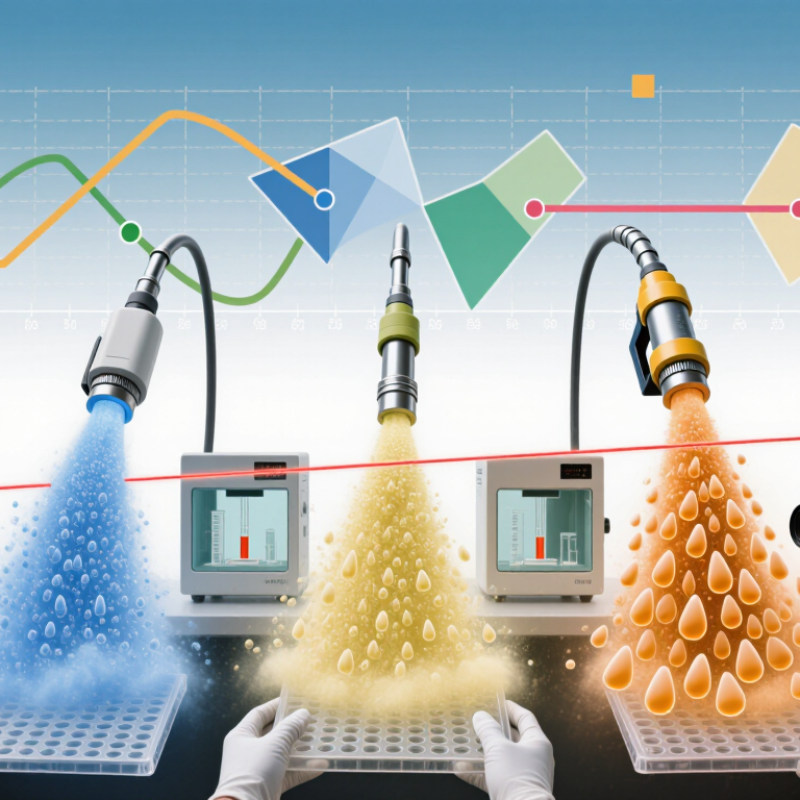
The best analyzer depends on what the spray must reveal. Laser diffraction measures a particle-size distribution across many droplets, making it useful for routine nozzle comparisons. It can struggle when a dense plume blocks too much of the laser beam. Phase Doppler systems measure individual droplet size and velocity, which helps when both matter. High-speed imaging can show spray shape and breakup, but image quality and lighting affect results. There is no universal winner.

Match the instrument to the spray and the test environment. A fine mist may need careful control of airflow and humidity, since evaporation changes droplet size. For a hot or pressurized spray, check whether the setup can safely reproduce operating conditions. Sampling position matters, too: measurements near the nozzle may differ from those farther downstream. Small setup changes can shift results. That is easy to overlook.

Tips: Define the size range and measurement location before comparing instruments. Check whether the plume is too dense for the chosen method, and record temperature, pressure, and spray distance. Repeat measurements after repositioning the nozzle. The data may still look uneven; investigate before treating that variation as noise.