10 Tips for Buying Metal Powder from Global Suppliers?
Buying Metal Powder from global suppliers requires more than comparing prices on a spreadsheet. Particle size, chemical composition, morphology, oxygen content, and moisture can affect production results. A material that looks suitable may fail during printing, coating, or sintering.
This guide presents ten practical tips for evaluating suppliers with greater confidence. It focuses on technical specifications, sample testing, certificates of analysis, lot traceability, packaging, and delivery reliability. Request clear documentation for every batch. Check whether the supplier can provide consistent test methods and relevant safety data. A polished website proves little. Real evidence matters more.
Experienced buyers still make mistakes. I have seen procurement teams approve attractive samples without checking long-term batch consistency. That shortcut can create rejected parts, delayed production, and expensive rework. Supplier audits, third-party testing, and small trial orders can reduce that risk. They cannot remove every uncertainty.
Global purchasing also requires careful attention to transport rules, import documentation, storage conditions, and destination-country requirements. Metal powders may need controlled handling because fine particles can create safety concerns. Confirm suitable packaging before shipment. Clarify responsibilities for inspection, damage, delays, and rejected material. Do not rely on vague promises.
The strongest supplier relationship is measurable. Define acceptance criteria, communication channels, and corrective-action procedures before placing a large order. These ten tips will help buyers ask sharper questions, recognize weak evidence, and select suppliers based on dependable performance rather than price alone. The process is not perfect, but it becomes safer and more predictable with disciplined verification.
Define Powder Grades by ASTM B214 Particle-Size Classification and Alloy Standards
10 Tips for Buying Metal Powder from Global Suppliers
Define powder grades with ASTM B214 particle-size classification, not vague terms like “fine” or “standard.” ASTM B214 provides a sieve-analysis method for metal powders. It records the percentage retained on, or passing through, specified sieves. Specify each fraction clearly, such as -100 mesh or +325 mesh. Confirm the applicable sieve tolerances under ASTM E11. ASTM B214 does not define alloy chemistry or certify performance. That distinction is often missed.
Match the particle-size range with the alloy standard and intended process. A powder for pressing may require different flow and apparent-density limits than powder for additive manufacturing. Request chemistry results, oxygen content, moisture, morphology, tap density, and batch traceability. USGS Mineral Commodity Summaries 2025 reports global mined nickel production at approximately 3.7 million metric tons in 2024. Large upstream output does not guarantee consistent powder quality. Conversion, classification, and packaging introduce variation.
Check the certificate against an independent sample test. A 2024 industrial additive-manufacturing market report identified repeatability as a major purchasing concern, especially for fine metal powders. Do not accept a certificate without the test method, sample location, and production lot number. I would also compare two retained samples under the same sieve procedure. It takes time. That is the uncomfortable part. ASTM chemistry and particle-size requirements should appear in the purchase specification, inspection plan, and acceptance criteria, not only in supplier marketing documents.
ASTM B214 uses sieve analysis to report the particle-size distribution of metal powders. The chart shows nominal ASTM E11 sieve openings commonly used as reference points in powder-size reporting, from coarse to fine classification. Particle-size requirements should be confirmed together with the applicable alloy, chemistry, and product standard.
Verify Chemistry, Oxygen, and Nitrogen Against ASTM E1019 Testing Limits
When buying metal powder from global suppliers, chemistry verification should begin before price comparison.
Ask for the lot number, production date, and complete certificate of analysis. Require carbon, sulfur, oxygen, and nitrogen results when these elements affect strength, fatigue, or powder flow. ASTM E1019 provides recognized methods for measuring these elements. It does not automatically define acceptable limits. Your material specification must set those limits clearly.
Request testing records identifying the exact method, instrument type, calibration status, and sample preparation. Oxygen and nitrogen can change through moisture, surface contamination, and handling. A sealed sample may tell a different story from an exposed one. Ask for a representative retained sample, not only a polished certificate. Use an independent laboratory for confirmation when the order is large or the application is critical. Compare duplicate results, units, detection limits, and rounding practices. Small details matter.
Do not treat a low number as proof of quality. Verify whether the result is below the method’s reporting capability. Check that the laboratory used a suitable ASTM E1019 procedure for the alloy family. Keep chain-of-custody records from sampling through testing. One overlooked transfer can weaken an otherwise strong investigation. It is tempting to trust familiar paperwork under deadline pressure. That habit deserves review. A reliable supplier answers technical questions directly and explains results outside the agreed specification.
Compare Morphology, Flowability, and Apparent Density Using ASTM B213 and B212
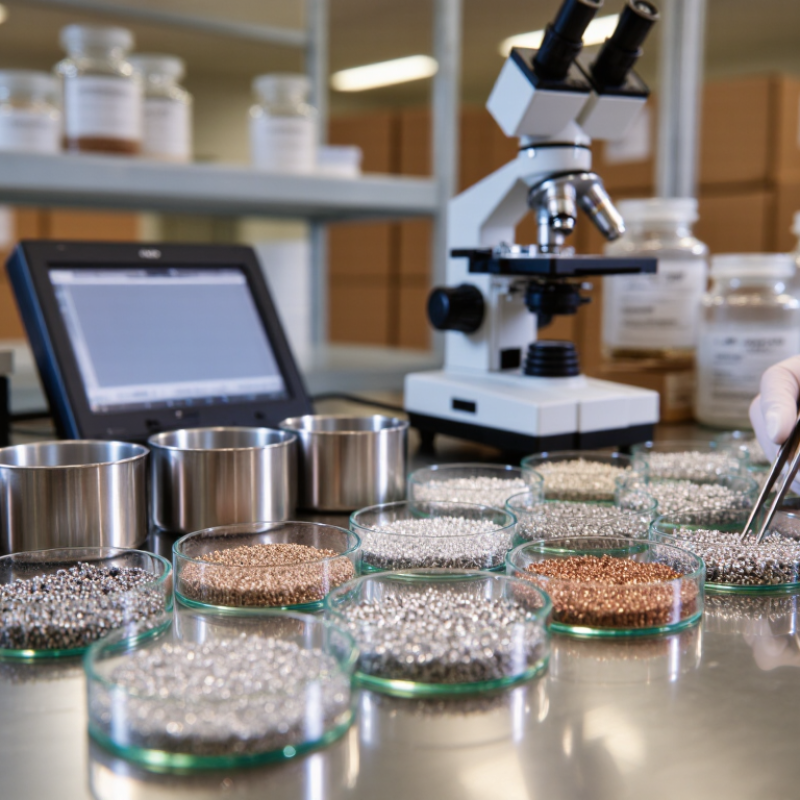
When buying metal powder from global suppliers, morphology, flowability, and apparent density deserve close comparison. Particle shape affects packing, spreading, and feeding behavior. Spherical particles usually flow more consistently than irregular particles, but shape alone does not predict production performance. Request microscopy images, particle-size distribution, and lot-specific test records. Do not rely only on a general technical data sheet.
Use ASTM B213 to compare flow rate through a Hall flowmeter funnel. Record the sample mass, conditioning, test temperature, and measured time. Humidity can change results, especially when fine particles form soft agglomerates. ASTM B212 helps evaluate apparent density under a defined funnel method. Compare values only when sampling and preparation are consistent. Small handling differences can create misleading results. Repeat each test when possible.
Ask suppliers for traceability from powder lot to test report, including sieve history, storage conditions, and production date. Check whether morphology was measured by microscopy or another documented method. A supplier with clear methods is easier to audit. Request independent verification for high-value purchases. It may expose an uncomfortable gap between certificate values and delivered material. Consider a small trial shipment before approving regular supply. During the trial, observe hopper discharge, spreading uniformity, and residue on equipment. ASTM results support comparison, but they do not replace process trials. Some powders behave well in a funnel and poorly in your actual machine.